
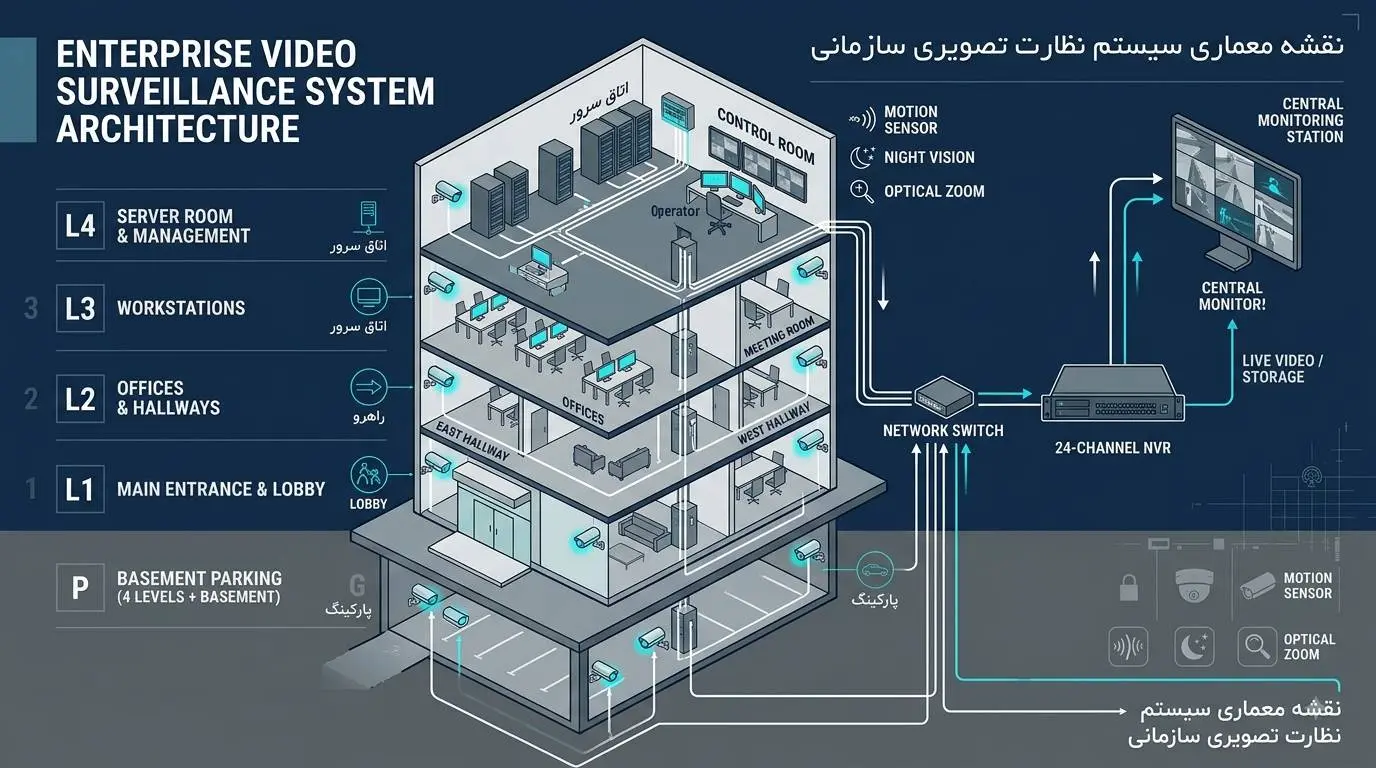
📌 A good surveillance system is not just about buying a few cameras; proper design, precise placement, and selecting the right equipment are keys to success.
CCTV cameras play an important role in securing organizational, commercial, and residential environments. However, for a surveillance system to be truly effective, it must be designed with careful needs assessment and thorough planning.
Step One: Determine Your Requirements
- Surveillance goal: Protecting entrances, monitoring the environment, process control, or event documentation.
- Installation environment: Indoor or outdoor, lighting and weather conditions.
- Coverage area: The expanse of the area to be monitored.
- Required quality: Higher resolution is needed for face or license plate recognition.
Choosing the Right Camera
Resolution
Cameras from 2 megapixels to 8 megapixels (4K) are available in the market. Higher resolution captures more details but requires more bandwidth and storage space.
Camera Type
Bullet cameras are suitable for long distances, dome cameras for indoor environments, and PTZ cameras for mobile monitoring. IP cameras provide remote access and higher quality.
Night Vision Capability
For nighttime surveillance, choose a camera with appropriate infrared range and consider installation positions that ensure sufficient lighting.
Principled Camera Placement
Placement matters more than the number of cameras. Entry and exit points, traffic routes, parking areas, and locations with valuable assets are priority coverage areas. Cameras should have appropriate viewing angles and be installed at safe heights.
Storage and Access
The recording device (NVR/DVR) and hard drive should be selected based on the number of cameras, resolution, and required image retention period. Remote access via mobile and the internet enables real-time monitoring.
Summary
Proper design, quality equipment selection, and standard installation are the three pillars of a successful video surveillance system. Entrusting this work to professionals prevents additional costs and future problems.
Frequently Asked Questions
The number of cameras depends on the size and layout of the environment; after a technical survey, a precise placement plan is prepared.
Yes, by connecting the system to the internet and secure configuration, images can be viewed from any location via mobile or computer.