
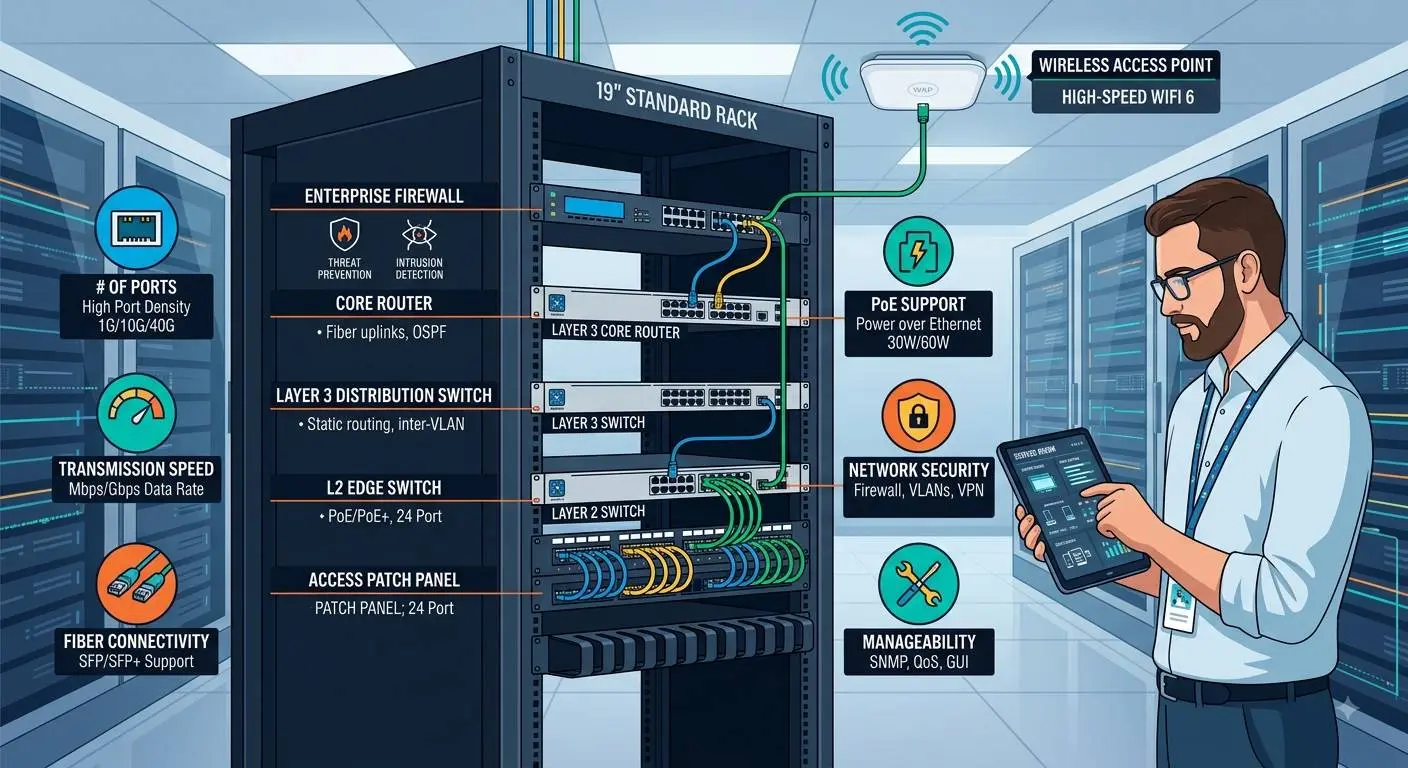
📌 Choosing network equipment is one of the most important decisions in infrastructure design — a decision that determines the quality and future of your network.
Network equipment is divided into two main categories: active equipment (switches, routers, firewalls, access points) and passive equipment (cables, patch panels, racks, conduits). Proper selection of both categories ensures stable network performance.
Active Equipment
Switch
The switch is the connection point for all devices on the network. Consider the following when choosing:
- Number of ports: Proportional to the current number of users and future growth.
- Port speed: Gigabit is today's standard; for main links, 10-gigabit ports.
- Management capabilities: Managed switches provide VLAN, QoS, and better management capabilities.
- PoE capability: For powering cameras and access points through network cables.
Router
The router establishes communication between different networks (e.g., internal network and internet). Router selection should be based on the number of users, traffic volume, and security requirements.
Firewall
The firewall is the first line of defense against threats. Next-Generation Firewalls (NGFW) provide integrated features such as intrusion prevention, content filtering, and VPN.
Access Point
For wireless coverage, standard access points with central controllers provide stable and secure connectivity throughout the environment.
Passive Equipment
Quality cabling (Cat6 or fiber optic), patch panels, and standard racks play an important role in network stability. Using low-quality passive equipment is one of the most common causes of network problems.
Key Selection Tips
- Needs assessment: Choose equipment based on actual requirements, not just brand or price.
- Scalability: Consider future growth potential.
- Warranty and support: Purchase from a supplier with genuine after-sales service.
- Equipment compatibility: Equipment should be compatible with each other and with organizational needs.
Summary
Choosing network equipment requires technical knowledge and accurate needs assessment. A principled selection gives you a stable, secure, and cost-effective network that serves organizational needs for years without problems.
Frequently Asked Questions
For organizations, managed switches are recommended as they provide features like VLAN, traffic prioritization, and better troubleshooting capabilities.
Used equipment may carry reliability and warranty risks; for critical infrastructure, new equipment with valid warranty is recommended.